2 months ago


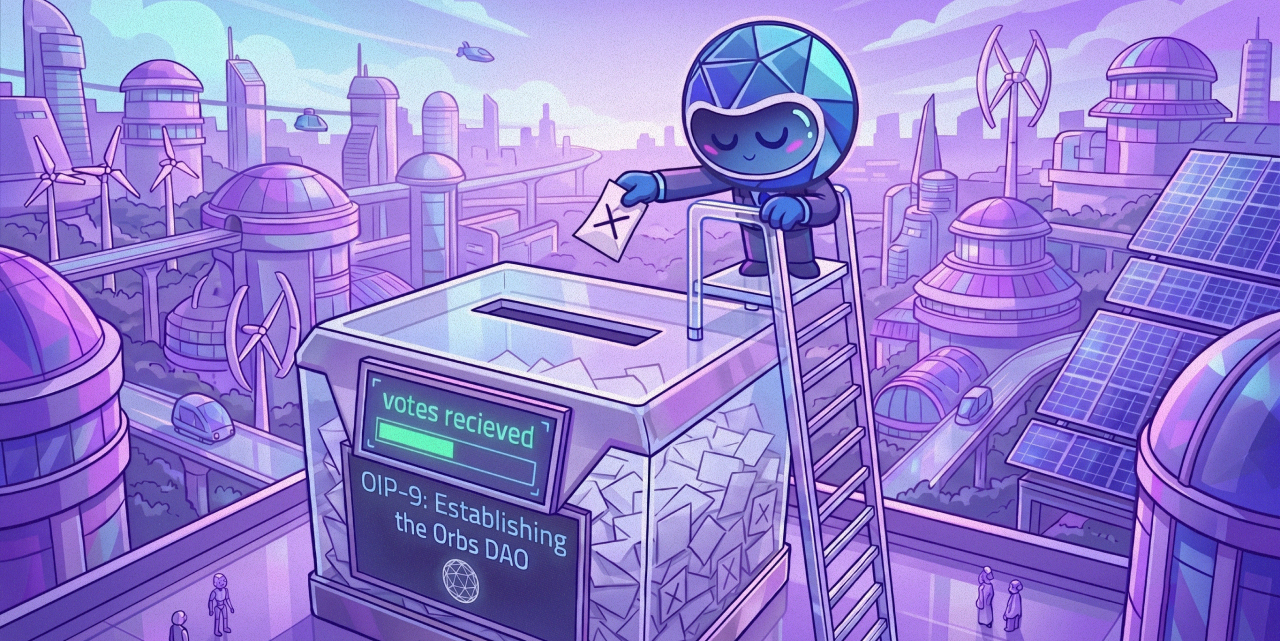
After years of building, the proposal to establish the Orbs DAO is here.
In our previous announcement, we shared that Orbs is moving towards the founding of the Orbs DAO: a governance structure designed to put meaningful protocol decisions in the hands of the community. We explained that this process would begin with two foundational votes: first, a vote to establish the DAO structure itself, and then a vote on Season 1 tokenomics.
The draft proposal for the first vote is now ready.
OIP-9 can be read here. This OIP proposes to officially establish the Orbs DAO and create its initial governance framework. This is the DAO's first governance layer: a controlled but meaningful transfer of authority over defined areas of the Orbs protocol.
This is the beginning of a structured path towards better decentralization.
Orbs has been building toward this moment for a long time.
The Orbs protocol was launched over seven years ago. Orbs governance was officially launched nearly four years ago. Since then, the network has grown into a real Layer-3 infrastructure project powering live products, integrations, and protocol activity across DeFi.
The next step is to formalize the role of the community in governing the protocol.
OIP-9 is the founding governance proposal of the Orbs DAO. If approved, it will establish the initial structure through which the Orbs community can exercise authority over specific areas of the protocol, beginning with network operations, Guardian oversight, major network upgrades, and selected protocol parameters.
This matters because governance should not be symbolic. The DAO should not exist only as a name, a forum, or a vague future promise. It should have real responsibilities, clear processes, and defined authority.
OIP-9 is the first step in creating that framework.
Under OIP-9, the initial voting members of the Orbs DAO will be the holders of tokens staked in the Orbs Proof-of-Stake contract.
The DAO will operate through the existing Orbs governance process, including OIP proposals and Snapshot voting. The DAO's authority will also be reflected on-chain through multisig wallets that hold defined roles in Orbs project smart contracts.
At launch, the Orbs DAO will have authority in four initial areas.
The DAO will have the ability to approve changes to a number of specific protocol parameters.
Initially, this will be accomplished by appointing the DAO to have the "Functional Manager" role within the Orbs PoS smart contract infrastructure. The Functional Manager controls 15 different functions, including the ability to change PoS reward rates, set minimum staking requirements and set defaults and maximum reward sharing rates between Guardians and their Delegators. The full technical list of roles is as follows:
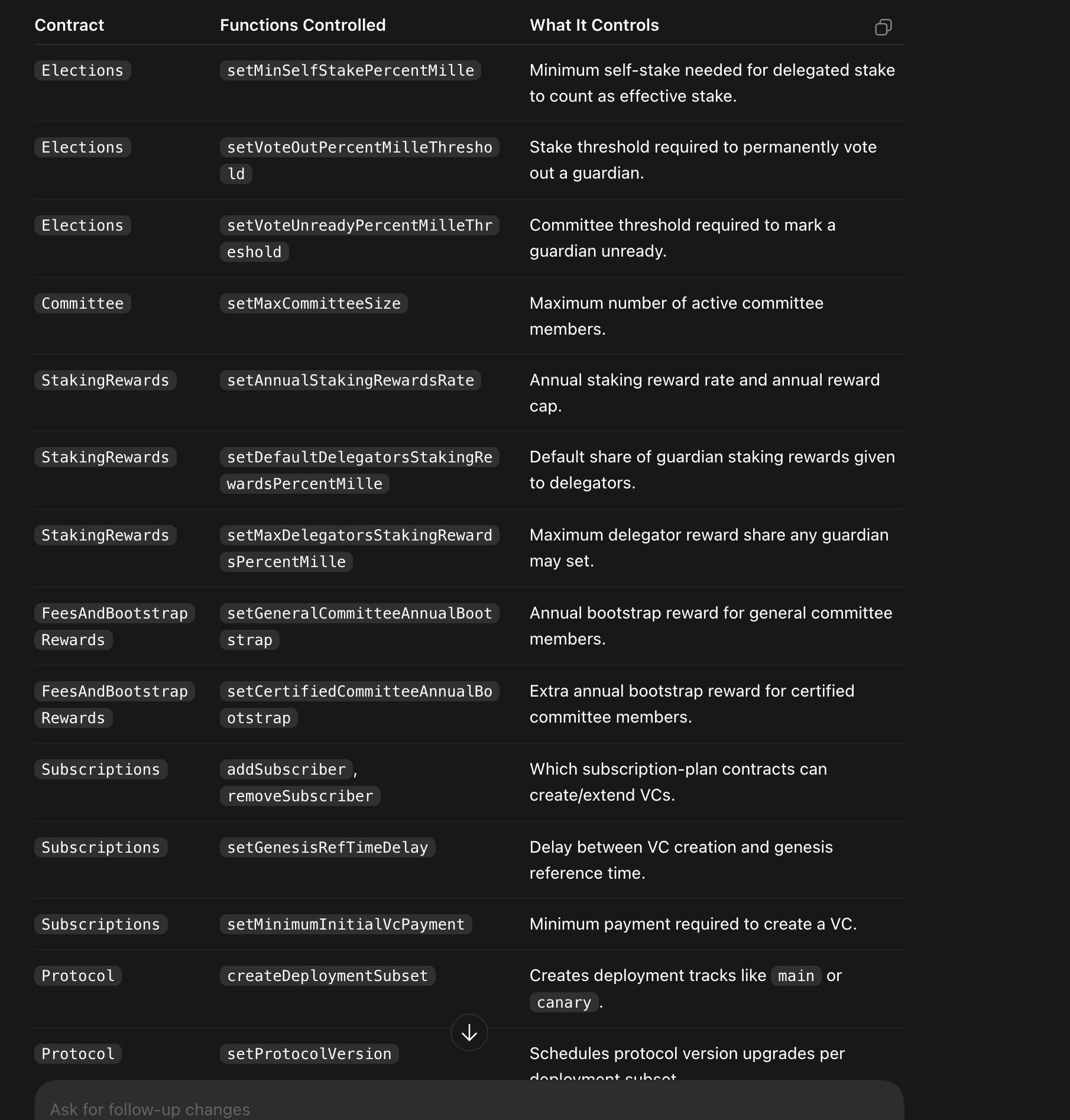
Additional parameters may be added to the DAO's authority in the future, subject to further governance decisions.
This gives the DAO an important role in shaping the economics and operation of the Proof-of-Stake Universe, while keeping the initial scope focused and manageable.
Guardians are central to the operation and security of the Orbs network. In order to participate in the certified committee (and receive payments in DAI to cover costs), Guardians must be certified on-chain after publicizing relevant information.
OIP-9 proposes that the DAO will have authority over Guardian certifications and revocations. This means the DAO will play a direct role in the standards and accountability mechanisms that support network security.
This is a natural place for DAO governance to begin. Guardians and Delegators are already the active participants in the Proof-of-Stake Universe. The DAO builds on that existing foundation.
All major network upgrades will be subject to DAO approval.
This includes the remaining final Orbs V5 milestones and any future major versions of the protocol.
Major upgrades shape the direction of the network. They should not be treated as routine technical changes. OIP-9 makes clear that major protocol evolution will require community governance.
The DAO will also have authority to approve new protocols and product modules that utilize the Orbs network.
This gives the DAO a role not only in maintaining the existing network, but also in shaping how the Orbs ecosystem expands.
As Orbs continues to develop new Layer-3 products and infrastructure, DAO approval can become a key part of how new network-level deployments are reviewed and adopted.
OIP-9 is intentionally designed as a first step.
The proposal does not attempt to transfer every possible area of authority to the DAO at once. It does not immediately place significant funds at direct risk or try to solve every question of tokenomics, treasury strategy, protocol revenue, liquidity, grants, and ecosystem funding in a single vote.
That restraint is deliberate.
Decentralization should be meaningful, but it should also be secure. A DAO that gains responsibility too quickly, without clear processes or operational readiness, can create unnecessary risk for the network and the community. In order to ensure the smooth functioning of the network, the OIP includes a provision providing emergency powers to the Orbs team, for situations in which an action needs to be taken quickly and it is not feasible to have a community vote. All such uses will need to be ratified afterwards by an Orbs DAO vote.
OIP-9 is the first step in a progressive decentralization model. Authority moves to the community in stages, beginning with important but clearly defined functions of the network.
This approach allows the DAO to build operational capacity, develop governance norms, and prepare for the next layers of responsibility.
OIP-9 is only the first layer.
Once approved, the Orbs DAO's authority can be expanded through future votes. Areas that may be addressed in future OIPs include protocol revenue, burn mechanisms, liquidity strategies, grant programs, and broader tokenomics design.
This connects directly to the seasonal governance model described in our previous DAO announcement. Rather than locking the community into rigid long-term parameters, Orbs will move toward a model where the DAO can evaluate priorities, make decisions, and adjust over time.
The expected next major step is Season 1 tokenomics, where the community will decide on the first steps.
But before the DAO can decide how to govern tokenomics, revenue, burns, rewards, liquidity, or grants, the community must first establish the DAO.
That is what OIP-9 does.
If OIP-9 passes, the Orbs team will set up two DAO multisig wallets:
The DAO Parameters Multisig
The DAO Certification Multisig
These multisigs will initially be operated by Orbs team members, but their role will be limited. They will only take actions based on OIP proposals that have been approved by DAO members through the Orbs Snapshot governance process.
The DAO Parameters Multisig will be set as the "Functional Manager" across the Orbs PoS smart contract architecture. The DAO Certification Multisig will be set as the Certification Manager in the relevant certification smart contract.
In addition, future major upgrades and future major protocol deployment approvals will be subject to DAO approval through OIP votes. Over time, as additional network updates and protocol deployment approvals move on-chain, DAO wallets can be given control over the relevant on-chain approvals.
The basic principle is simple:
The DAO votes.
The approved decision is implemented.
The implementation must match the approved OIP.
The purpose of this first vote is not only to create a DAO in name.
The purpose is to create a governance framework that is secure, transparent, accountable, and capable of expanding over time.
This structure has several benefits.
First, it gives the DAO real authority from day one. The DAO will not merely discuss future decisions; it will govern defined areas of network operation.
Second, it protects the network by keeping the initial scope focused. The DAO begins with important responsibilities, but without immediately putting significant funds at direct risk.
Third, it creates a foundation for Season 1 tokenomics. Once the DAO exists as an operating governance body, it can begin to address larger questions about revenue, rewards, burns, liquidity, and tokenomics.
Finally, it aligns governance with the participants who already help secure the network: the holders of tokens staked in the Orbs Proof-of-Stake contract.
The Orbs DAO will only be as strong as the community that participates in it.
This first vote is especially important because it sets the foundation for what comes next. Future DAO decisions may address protocol revenue, token economics, burn mechanisms, liquidity, grants, network upgrades, and other major areas of the Orbs ecosystem.
But the first question is more basic:
Should the Orbs DAO be formally established, and should it receive its initial authority over defined areas of the protocol?
That is what the community is now being asked to decide.
Guardians, Delegators, and all participants in the Orbs Proof-of-Stake Universe should review OIP-9 carefully, understand the proposed structure, and participate in the vote.
Orbs did not rush into this moment.
The project spent years building real products, real integrations, real network activity, and real governance infrastructure. The DAO is now being built on that foundation.
OIP-9 marks the beginning of a new phase: the Orbs community moving from governance participation toward formal DAO authority.
This is the first governance layer.
Season 1 comes next.
And from here, the future direction of Orbs becomes increasingly a matter for the community to decide together.
To read the full OIP-9 proposal and share your feedback with the community before voting begins, click here.
We use cookies to ensure that we give you the best experience on our website. By continuing to use our site, you accept our cookie policy.